



In recent years, the spread of fake news has become one of the main threats to the quality of information and public opinion, distorting perceptions, judgements and actions. The media sector has undergone a profound transformation: we have moved from print newspapers to websites and, finally, to social media as the main source of news. In this process, journalistic professionalism – understood as a commitment to verification and the pursuit of truth – has gradually been eroded.
Today, anyone can disseminate content, regardless of its reliability. Consequently, the ability to distinguish between verified information and manipulated content is diminishing, particularly among younger people, with a direct impact on their perception of reality.
Making the phenomenon even more complex is artificial intelligence, which allows for the creation of highly realistic content, such as deep fakes or automated articles, making it increasingly difficult to distinguish the true from the false. At the same time, social media
algorithms favour the spread of emotional and polarising content, amplifying false or distorted news.
This alters collective perception and can directly influence democratic processes, such as elections, public debates and political decisions. Added to this are coordinated disinformation campaigns: governments and international actors use networks of bots and fake accounts (‘bot networks’) to amplify content and steer public debate through reels, advertisements and comments. This phenomenon, known as astroturfing, creates the illusion of spontaneous consensus on complex geopolitical issues.
Contemporary forms of communication are not neutral: images, sensationalist headlines, memes and short videos are designed to grab attention quickly, often turning information into a tool for manipulation.
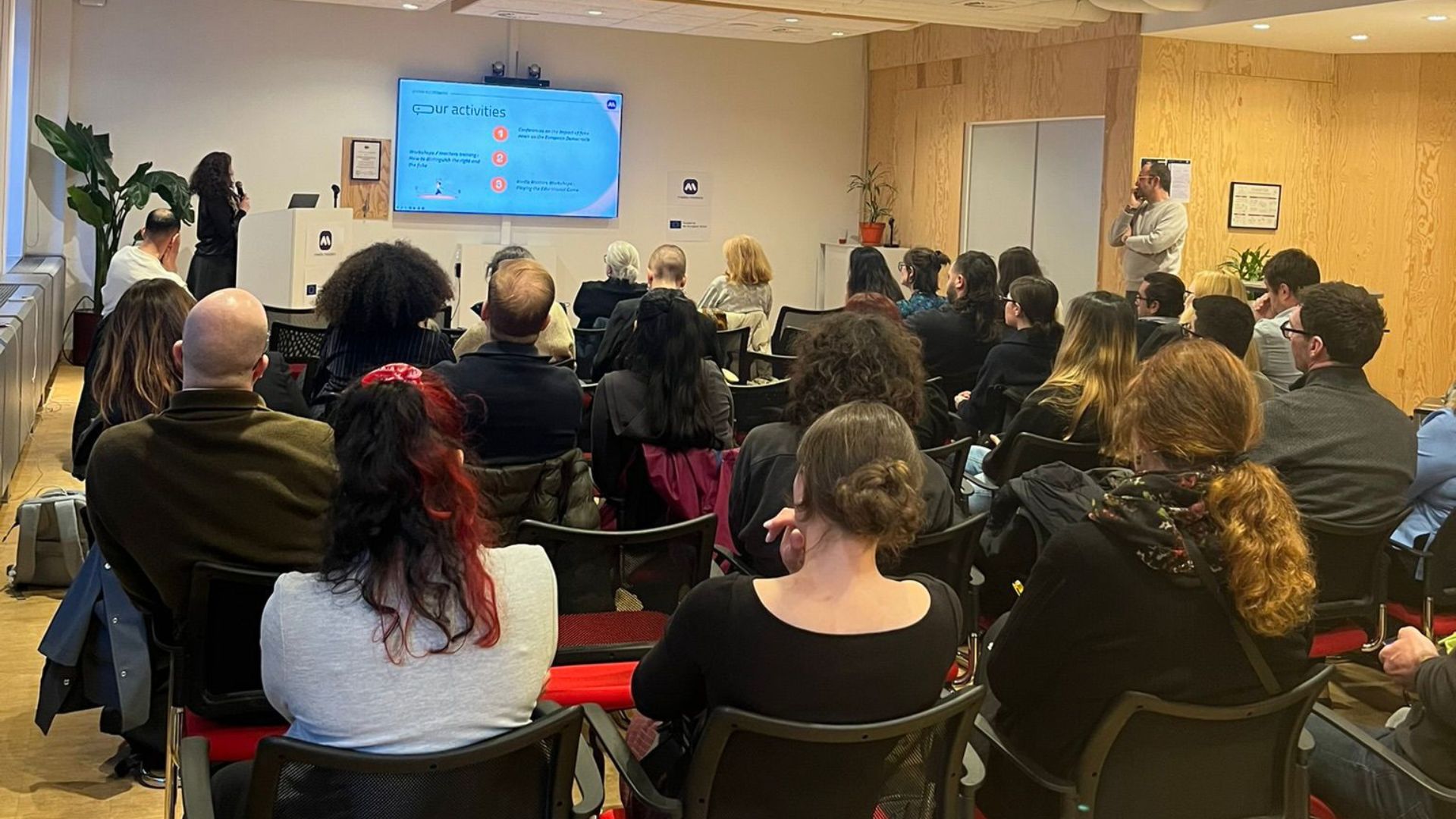
In this context, media literacy and the development of critical thinking become fundamental to strengthening democracy. We are therefore delighted to have contributed to the organisation of the final event of the MEDMAS project in Brussels, as an associated partner, funded by the European Union, alongside international guests who are experts in the field of communication and media literacy.
Although this marks the final official event of the project, our commitment continues. We continue to promote the values of MEDMAS: critical thinking, media literacy and European citizenship, and to collaborate with Zaragoza Joven through workshops such as ‘No cuela: aprende a detectar bulos en redes’, using the educational game developed by the project.
In an age where information is accessible to all but not always verifiable, investing in the critical education of the younger generation is essential to protect and strengthen European democracy.

